Home Improvement Cost Guide
A practical guide to budgeting for home renovations. Covers material selection, contractor costs, permits and fees, contingency planning, and how to avoid the most common budgeting mistakes.
Introduction
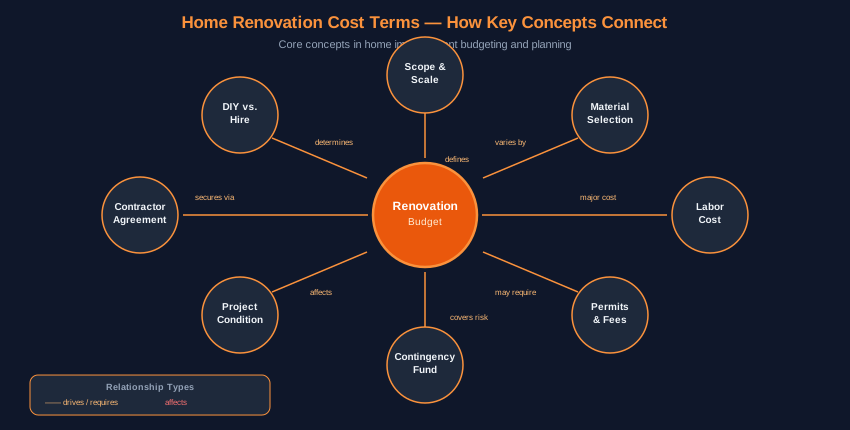
Home renovation budgets fail for predictable reasons: costs were underestimated, scope creep crept in, permits were overlooked, or the unexpected appeared behind a wall. This guide walks through each component of a renovation budget so you can plan accurately, avoid surprises, and make informed decisions about where to invest and where to save.
Note: Actual costs vary significantly by location, project type, and market conditions. All cost ranges in this guide are approximate starting points — verify current local material and labor rates for your project before budgeting. Per-square-foot estimates for common renovation types are published annually by organizations such as NAHB (National Association of Home Builders), Remodeling Magazine, and regional builder associations; these provide useful national benchmarks but always supplement with at least three local contractor quotes.
Step 1 — Define Scope and Scale
Before getting a single quote, define what you are actually doing. A clear scope prevents the most common budget destroyer: scope creep, where small additions accumulate into a dramatically larger and more expensive project.
Define Your Scope
- What specific work needs to happen? (e.g., "replace kitchen countertops," not "fix the kitchen")
- What is the minimum that achieves your goal? (This is your starting point — additions come after the budget is set)
- What is the ideal outcome if budget allows?
- Are there related issues that fixing the primary problem might uncover? (e.g., replacing a water-damaged floor may reveal subfloor damage)
Set a Realistic Budget Range
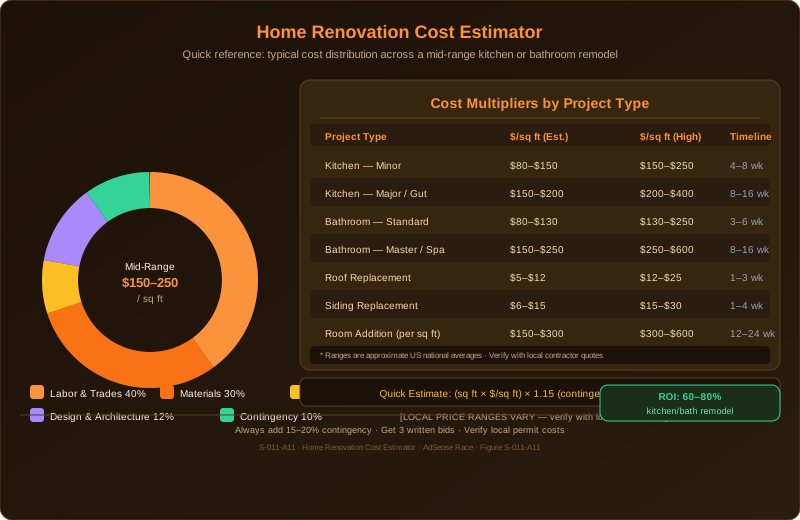
Estimate on a per-square-foot basis for major projects, then add 15–20% to the upper bound as a buffer. National per-square-foot cost ranges by project type are published by NAHB, Remodeling Magazine, and regional builder associations — use these as a starting baseline, then adjust based on local contractor quotes and your specific project specifications. The per-square-foot figure should include:
- Materials and supplies
- Labor (both contractor and any specialist trades)
- Permits and inspection fees
- Site preparation and cleanup
- Contingency for the unexpected
Step 2 — Materials and Material Selection
Material costs can range from 25% to 50% of a renovation budget depending on the project type and the quality level chosen.
Quality Tiers
- Economy / Builder grade: Functional and budget-appropriate. Suitable for rental properties, budget flips, or areas of low visual importance.
- Mid-grade: Significantly better aesthetics and durability for only moderate cost increase. This is the sweet spot for most owner-occupied renovations.
- High-end / Custom: Designer materials, imported stone, custom millwork. High visual impact and longevity. Significantly increases cost and lead times.
Cost-Saving Strategies
- Shop sales and clearance: flooring, tile, and fixtures often go on clearance when display models are updated.
- Consider material alternatives: luxury vinyl plank offers similar aesthetics to hardwood at a fraction of the cost. Quartz composite offers similar performance to natural stone at lower cost.
- Mix tiers: use high-end materials in focal areas (a kitchen island, primary bathroom) and mid-grade in secondary spaces.
- Time your purchases: contractors typically offer discounts on materials during their off-season.
Step 3 — Labor Costs and Contractor Selection
Labor typically accounts for 30%–50% of a renovation budget, sometimes more for labor-intensive projects such as tile work, custom carpentry, or extensive demolition. This range is widely cited by general contractors and industry associations as a realistic planning benchmark for most U.S. residential renovation projects — the exact split between labor and materials varies by project type and quality level.
Contractor Types
- General contractor (GC): Manages the entire project, hires and coordinates sub-trades (electricians, plumbers, framers), handles permits and scheduling. Best for projects involving multiple trades. The GC typically marks up sub-trade invoices by 10–20%.
- Specialty contractor: Focuses on a single trade — electrical, plumbing, HVAC, roofing. Suitable for smaller single-trade projects. You manage coordination yourself.
- Handyman: Appropriate for small jobs that do not require a licensed contractor — fixture replacements, minor carpentry, painting. Verify licensing and insurance requirements in your jurisdiction.
How to Evaluate Contractors
Understanding Hourly Rates
Contractor hourly rates vary significantly by region, trade, and experience level. Trade associations and state contractor licensing boards often publish rate ranges or hourly wage surveys for their regions — these provide useful benchmarks for initial budgeting. Ask for a fixed-price bid for the full scope rather than an hourly rate — it shifts risk to the contractor and protects you if the project takes longer than expected.
Step 4 — Permits and Fees
Permits are often forgotten in renovation budgets until they show up mid-project as an unexpected charge. Most municipalities require permits for structural work, electrical, plumbing, HVAC, and anything that alters the footprint of the home.
Permit costs are highly local — ranging from a few hundred dollars for minor work to several thousand for major structural renovations. Your local building department's fee schedule is publicly available — typically on the municipal website or obtainable by phone. Permit costs are often overlooked in renovation budgets; include them from the start to avoid surprises mid-project.
When permits are required:
- Structural changes (removing walls, adding rooms, roof modifications)
- Electrical work beyond simple fixture replacement
- Plumbing work beyond simple faucet replacement
- HVAC modifications
- Decks and outdoor structures over certain size thresholds
- Any work that alters the footprint or height of the home
Skipping required permits can result in fines, difficulty selling your home, and insurance coverage problems. Always verify permit requirements with your local building department before starting work.
Step 5 — The Contingency Fund
The contingency fund exists for the things you cannot see until you open a wall. It is not optional — it is an essential part of every renovation budget.
Recommended contingency by project type:
- Kitchen and bathroom remodels: 15–20% of total budget. These rooms have extensive plumbing, electrical, and cabinetry that often reveals hidden damage.
- Room additions: 10–15%. More predictable than a gut renovation but foundation and structural surprises still occur.
- Single-trade projects (roofing, siding, window replacement): 5–10%. Less exposure to hidden conditions.
How to use it: track any use of contingency separately. If you use contingency funds, that is information — it tells you whether your original estimate was accurate, which improves your budgeting on future projects.
Step 6 — Financing Your Renovation
Cash / Savings
The cheapest way to finance a renovation — no interest, no debt. Best for projects that your savings comfortably cover without depleting your emergency fund.
Home Equity Line of Credit (HELOC)
Borrow against the equity in your home at rates typically lower than personal loans or credit cards. You draw as needed and pay interest only on what you borrow. Best for larger projects where you want flexibility in timing of draws.
Cash-Out Refinance
Refinance your existing mortgage at a lower rate while pulling out equity in a lump sum. Best when current mortgage rates are lower than your existing rate and you have significant equity.
Contractor Financing
Some contractors offer financing — read terms carefully. Interest rates on contractor financing are often higher than home equity options.
Personal Loans
Unsecured loans based on creditworthiness. Faster to obtain than home equity products but typically higher interest rates. Best for smaller projects or when you do not have home equity.
Common Budget Mistakes to Avoid
| Mistake | Why It Hurts | Prevention |
|---|---|---|
| Not getting written estimates | Scope and costs are unclear; disputes arise | Require itemized written bids |
| No contingency | Any surprise derails the project or forces poor decisions | Build 10–20% contingency into every budget |
| Ignoring permits | Unexpected fees; fines; insurance and resale problems | Check permit requirements before signing contracts |
| Choosing contractor solely on lowest price | Lowball bids often mean corners are cut or the contractor will recover via change orders | Evaluate quality, references, and communication — not just price |
| Changing the scope mid-project | Change orders are expensive — often 20–30% more than the original bid for equivalent work | Lock scope before starting; defer additions to the next project |
| Not verifying insurance and licensing | You could be liable for injuries, property damage, and code violations | Request and verify certificates of insurance and licenses |